Jochen Dietrich
Siegen
Niemcy – Deutschland
Exhibitions
one man shows
(selection)
98 Cine-teatros
de Portugal. Museu da Imagem em
Movimento, Leiria, Portugal (catalogue); Tour:
Galeria de Arte do
IPJ, Museu Regional, Faro; Cine-teatro Pax Julia, Beja ; Galeria
Municipal e Encontro de Cinema
99 Cine-teatros
de Portugal , Städt. Galerie Haus Seel, Siegen
Torre dos
Relógios. Casa das Artes Torreão, Porto Alegre, Br
02 Jochen
Dietrich. Fotografia. Galeria arquivo, Leiria
Vom Ansehen der
Dinge. Museum of the City of Iserlohn, Iserlohn
03 Medidas de
Segurança Fotogaleria ImagoLucis, Porto (catalogue)
04 Viagens na
terra deles. Ateliê da Imagem, Rio de Janeiro (catalogue)
Jochen
Dietrich, Fotografie. Galerie Allehof, Neuenrade
05 Die
Wunderbaren Städte. IHK-Galerie and galeria art&living,
Siegen
06 A Camera
Obscura visitável, Museu da Imagem em Movimento, Leiria und,
Centro Cultural de Belém, Lisboa,
07 As Cidades
Maravilhosas. Atelié da Imagem, Festival FotoRio, Rio de Janeiro,
Brasil
11 Nora. Eine
Idylle. Galerie Associação a9)))), Leiria, Portugal
16 Reisen im
Land der Anderen. Kreuztal Kulturbahnhof
Camera
Catacumba. Siegerlandmuseum und ASK Siegen
group shows
(selection)
97 Filmland
Portugal. Deutsches Filmmuseum Frankfurt, double show with Wim
Wenders
98 Accrochage
des artistes du 4ieme programm; Pépinières européennes
pour jeunes artistes, Paris
01 Pinhole
Photograph. Adirondack Community College Gallery. NY, USA
09 Blicke. Von
Außen. Galerie Gotisches Haus, Berlin-Spandau
10 Goalgetting.
(catalogue) Galerie des Winchester Mansion Hotel, Kapstadt (SA),
Krönchencenter Siegen;
12 Body and
Bodies, Transgressions and Narratives/ Corpo e Corpos,
Transgressões e Narrativas.
14 Poetics
of Light.
New Mexico History Museum, Santa Fé, USA
21 Analog.
Fotoedition Fach Kunst der Universität Koblenz-Landau
books
and articles (selection)
Cine-Teatros
de Portugal.
Fotografien von Joxchen Dietrich,Texte von Daland Segler, José Manuel
Fernandes
Camera
obscura.
In: Porto Arte, Revista do Instituto de Artes da UFRGS, Porto Alegre,
2/99
Camera
obscura. Convidando o mundo a falar. In:
Jobim e Souza, Solange (Org.): Mosäico - Subjetividade, Imagem e
Vom
Ansehen der Dinge
-
Die Camera Obscura als Medium in der Lerntätigkeit. Oberhausen,
Athena 2001 (=
Camera
Catacumba.
In: Ana Angelica Costa (Hr.) Possibilidades da Camera Obscura. Rio de
Janeiro 2015
Camera
Catacumba - Images from the other side
Jochen
Dietrich
„Camera
Obscura” or „Pinhole Camera”? It is undisputed that
this instrument of image production is a combination of two basic
elements: dark chamber and small opening. The name Camera Obscura
only emphasizes the first part, the dark chamber, and leaves the
question unanswered as to whether or not a lens, i.e. an element for
refracting light, is attached to the small opening. The
internationally more common term „pinhole”, like the
„sténope” used in the French-speaking world, such as
„diffraction” and „pinhole camera”
photography, draws our attention to the other part of the apparatus
and uses the pinhole as a difference maker as opposed to the glass
lens.
In terms of its use
since the 17th century, the camera obscura is a box fitted with glass
lenses. On the way to photography we are still missing a third thing:
the chemical recording of the image, the fixation of the image.
However, the pinhole camera is already marginalized in the early
phase of the history of discovery (for example with Porta) - as
cumbersome, unsuitable, overall inadequate. When photography was
invented in 1839, nobody used pinhole cameras. It was not until the
considerable increase in the light sensitivity of photographic plates
around 1880 that it was even possible to produce photographs using
these „defective” devices - and as soon as (new)
objectivity prevailed in the aesthetic discourse, that short pinhole
hype was all over again. If one applies strict differentiation
criteria and defines the lensless, the pinhole camera as the „other”
medium, then one has to distinguish it not only from the history of
the invention of photography, but even from the history of all the
image producing media ever since the 17th century. Nobody used
pinhole cameras for image production, the dark chamber always was
equipped with glass lenses. With all the more right then the pinhole
camera could be viewed as a „new” medium.
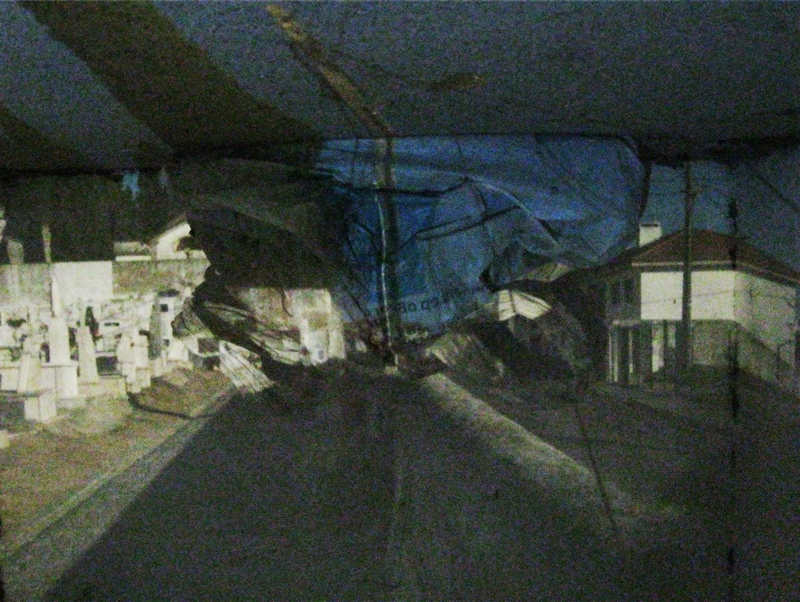
Tombs like the one
shown above are, in summary, pinhole cameras. Dark room, limited
opening, everything is there. And we know that there is an image
inside, even if it was just a blurred one. But it is there, even
without a photographer coming by. Everyone can decide for themselves
whether the opening was necessary for smelly gases evaporating a
decomposing body - or for the soul, giving way to paradise. But it is
undisputed that the opening acts as a pinhole projecting the world of
the living into that of the dead.
The Portuguese
Graveyards Tour 2013
Although
the images in this series can certainly be
considered just for their pictorialistic qualities, they are - as in
most of my earlier works - primarily concerned with the ways
and acts of
photographic image making. The pictures were produced during a trip
through central and southern Portugal in the week before All Saints'
Day in 2013. Occupied with a simple construction made of cardboard,
aluminum foil and black cotton fabric, I visited several graveyards
and transformed ossaries and graves (that were temporarily not
occupied) in pinhole cameras. The projection of the landscape or
cityskape into the interior of the rectangular chamber was recorded
with a standard digital camera. I placed that in the grave site in
the wall with the self-timer activated, then closed the chamber with
the „perforated” cardboard cover and counted the seconds.
What you see in the
picctures are landscapes of the dead. I don't need to talk about the
metaphorical richness of this process technically so simple, crude
and rudimentary. I didn't change anything else on site. Sometimes
there were objects in these caverns: empty bottles of chlorine
cleaner, paper flowers, broken marble tablets, candles. I left them
where i found them, remnants of life and death, souvenirs of the
business of commemorating the dead. And business there was a lot, in
the Alentejo and Algarve cemeteries in the week leading up to All
Saints Day. The Portuguese live with their dead; many of the graves
have windows, nowadays. People keep these „apartments”
nice and clean, renew wreaths and containers of plastic flowers,
replace the tattered doilies and curtains with new ones. The glass
panes in front of the coffins are cleaned, the gravestones are
brushed. In between you stretch your back, smoke a cigarette, have a
chat, and help yourself from the picnic basket. Nowhere else in the
world have I seen so many graves standing open, so many coffins at
arm's length in front of my eyes, and by no means all of them safe
and locked. And nowhere did I see people who seemed less concerned,
less worried than here, in these portuguese graveyards. Nobody
noticed my strange activities anyway. I was just another busy person
in a cemetery buzzing with vitality.
All the hustle and
bustle is not reflected in the pictures, the exposure time prevents
that. The world of the living lies before us quietly and empty when
you look at it.
Vita:
*1965 in Siegen
- studies of Fine Arts, German language and literature, educational science at Universities of Münster, Siegen, Aveiro and Lisbon; Dr.phil. In Educational Sciences at Siegen University
- 2000-2003 Head of Photographic Collection at Museu da Imagem em Movimento, Leiria (P)
- 2001-2003 Professor adjunto at Instituto Politécnico de Coimbra (P), teaching theory and practice of photography
- 2004 – 2014 Fine Arts Teacher at secondary schools at Plettenberg, Bendorf/Rhein and Hilchenbach
- since 2014 Headmaster at Gymnasium Stift Keppel secondary school, Hilchenbach
AVANCA´98, Estarreja, Câmara Municipal, Évora; Casa das Artes,
Centro Português de Fotografia, Porto;
Museu das Comunicações,
Lisboa
Portugal.
AVANCA Festival de Cinema, Estarreja (P)
Museu da Imagem em Movimento,
Leiria, Portugal
und Jochen Dietrich. Leiria, Ed. Museu da Imagem 1998
Construção de Conhecimento; Rio de Janeiro, Ed. Rios
ambiciosos 2000
Dissertation, Universität Siegen 2000)